
Be a Champion for Each Kid

At each back-to-school inservice, I share a message that I hope will inspire staff and remind them of the scope of our work. This year, I focused on what we can control. We can’t tell parents what to do. We can’t make decisions for other teachers in their classrooms. And we can’t force kids to do things they don’t want to do. But we can control how we stand up for students and their needs. We can be a Champion for Each Kid. Rita Pierson says every child deserves to have a champion. An adult that will be there for them. No matter what. I hope the message below demonstrates why this is so important, and why EACH is more powerful than ALL.

Why Being a Champion is Important
In some of his work, Malcolm Gladwell writes about capitalization as a measure of society. In this way, capitalization means the number of people who could have achieved a certain outcome who actually did. This can be firefighters, professional football players, teachers, or graduates.
In the United States, we like to think that we are really good at capitalization. There is a belief that if you work hard enough, that you will be able to go to college, buy a house, and have a family. Be a success. The American Dream. It’s all within reach if you want it enough.
The reality is that the American Dream is not a reality for everyone. This image shows the percentage of people who grew up in the bottom income quintile who reached the top income quintile. The reality is, people tend to become what they come from. Unless…

Unless there is an advocate, a champion, on their side. Someone who will give them a first chance, a second chance, or more. Someone who will give them a hand up. A shoulder to lean on. Someone who sees their potential and helps them see it themselves.
In special education, a champion is critical to the success of students because the simple fact of being born with a disability means that our students are in a position to be left behind. In the past, society showed that students with disabilities would be disproportionately affected by poor academics, less access to grade level instruction, and more significant disciplinary actions.
The IDEA is first and foremost a Civil Rights Law meant to even the playing field. It gives each student the right to a Free Appropriate Public Education in the Least Restrictive Environment and it means decisions are made with the data that is available to the IEP team. As a champion for each student, we need to keep these things in mind to make sure each student gets what they need.
Least Restrictive Environment and Ways to Improve It
The Least Restrictive Environment is a key area for WCKSEC because we are currently under state goals for inclusion. When considering LRE, we need to keep in mind a couple of things.
More service does not mean better service. When we aren’t sure what to do with a student, or when students first qualify, it can feel like we just need to give the student a bunch of services. But this doesn’t have to be the case.
Content Area Specialists and Access Specialists. We need to focus on the roles of general education teachers as content area specialists and special education teachers as access specialist to make sure the strengths of each staff member are able to support the learning of each student.
Effective Strategies. We need to make sure accommodations, modifications, and other supports are considered. If someone is unsure about how to provide these supports, then we need to help them get training to support that.
Related Services. The last area where we can impact LRE is with related services, and considering alternatives to direct service.
Our district’s MTSS work has focused on what makes a successful high school graduate. For our students with disabilities, the path to being a successful high school graduate includes access to grade-level instruction. We know that more students understand the grade-level discussions than we originally thought, and we know that access to that instruction is the key to closing academic gaps. We will only see this maximized if we are a champion for each kids. But how do we do that?
How to be a Champion for Each Kid
Here are some great ways to be a champion for each kid you work with.
Make sure that decisions are made with the data available. Focus on the facts about the student and the facts about the learning environment, and work on addressing the mismatches in between.
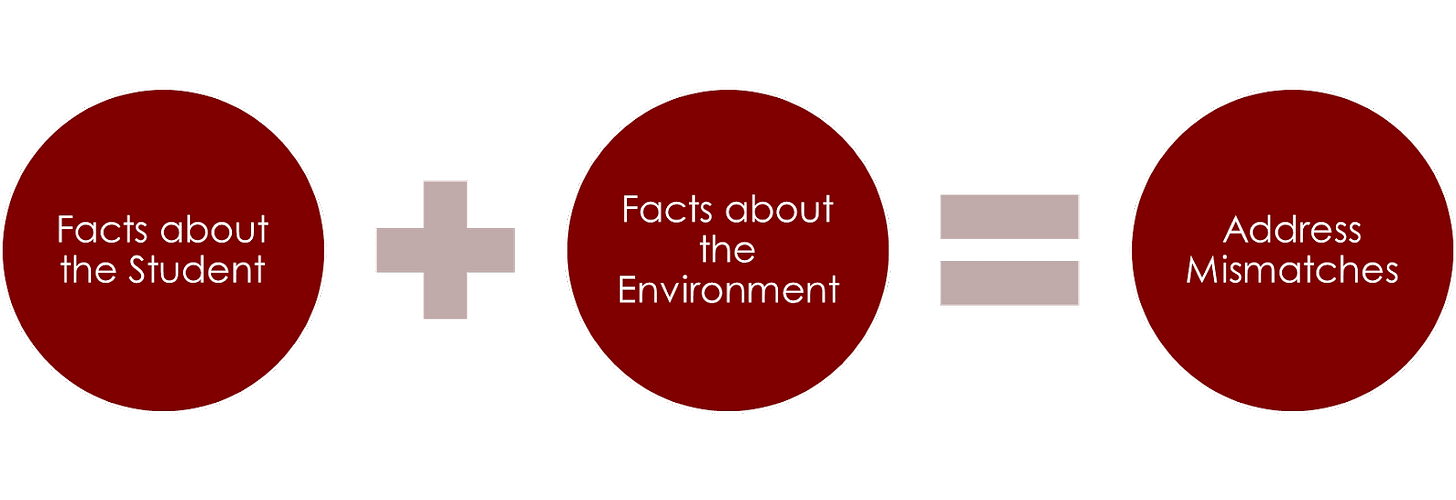
If data isn’t available, we find ways to get it.
This isn’t facts about the other students. Or Facts about how irritated someone is. It isn’t that there are mismatches so we find somewhere else with the hope of fewer mismatches. It’s about the kid, the classroom, the instruction, and what we as the adults can do to make it work.
Working Through the Continuum of LRE. Avoid jumping multiple steps at one time, and avoid initial IEPs that take the student away from their peers more than 20% of their day. Champions make sure students move through the continuum instead of starting with more restrictive placements.


Identify the Big Rocks in the Curriculum. If a reason for not moving a student to a less restrictive environment is because the academic gaps are too large, we need to focus on filling in the big rocks of the curriculum. What are big rocks? Big rocks are the things in one lesson or class that must be understood in order to understand the next lesson or class. If we are to close academic gaps these Big Rocks must be identified and focused on.

Avoid the tip of the Pyramid Problem. Every class, every school has a student that is difficult to reach, or difficult to figure out. Once the team figures out a way to support that student, the next student who fills that spot is often met with the same solution. We need to be sure that we are seeing each student as their own case and making sure we are building our own capacity to support them. Just because one student needs a more restrictive placement, does not mean another similar student needs that same placement.

Let other people know when they are doing good things for kids. There are times when champions can feel like they are alone. If you see someone going to bat for a kid. Let them know you see it and appreciate it.
So how are you a Champion for Each Student? What are you doing to make sure each kid gets the chance to access grade-level instruction?